
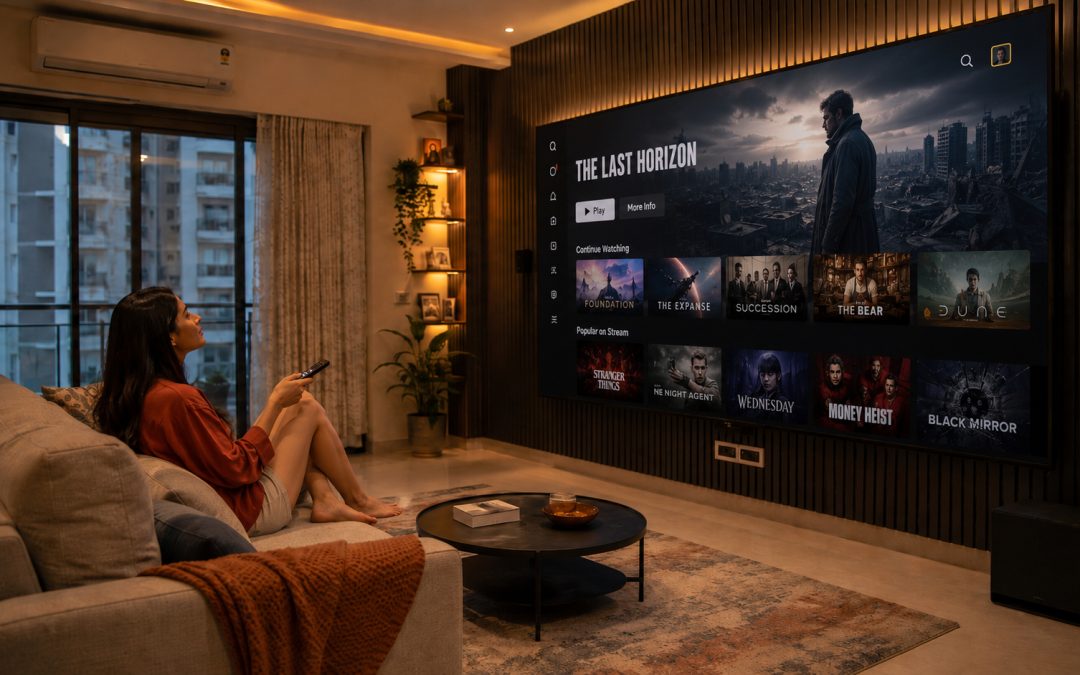
A lot of people now walk into a shop thinking about a 65-inch, 75-inch or even 85-inch TV.
That is normal now.
TVs have become bigger, thinner and better quality, and many customers do not see 65 inches as a large TV anymore. In many homes, 65 inches has become the normal size. A 75-inch TV is also very common now, especially in lounge rooms. Some customers are also moving into 83, 85 and even 98-inch TVs.
But that does not mean every room suits a bigger TV.
A TV can look reasonable in a showroom and then feel much larger once it is sitting by itself in your own lounge room. In the shop, the TV is usually surrounded by other large TVs, bright lighting, high ceilings and a lot of open space. A 75-inch TV may not look as large when it is sitting next to an 85-inch or 98-inch TV.
At home, it is different.
The same TV may be sitting on one wall, above a cabinet, opposite your couch, with no other large screens around it. That is when people often realise how big it actually is.
So the real question is not just:
What size TV can I fit on the wall?
The better question is:
What size TV will feel comfortable in the room I actually watch TV in?
Bigger TVs are more common now
There was a time when a 55-inch TV felt large.
That has changed.
In many homes now, 65 inches is a very common size. A lot of customers now see anything under 65 inches as small, especially for a main lounge room TV. A 75-inch TV is also very common, and 85-inch TVs are becoming much more normal in larger rooms.
That does not mean everyone should buy one.
The bigger the TV gets, the more important it is to take into account the the room it will be going into. The wall size, couch distance, cabinet height, room layout, viewing angle, picture quality, sound setup and glare all start to matter more.
A larger TV can give you a better experience when the room suits it. It can make movies, sport and streaming feel more immersive. But if the room is too small or the couch is too close, it can also feel too large, too high, or too dominant on the wall. If you walk into an empty movie theatre and had your choice of any seat, you usually wouldn;t pick the first row.
That is why bigger is not always better.
The most common problem is sitting too close
The most common problem with oversized TVs is not always the wall.
It is the seating distance.
Many people buy a large TV because it looks great in the shop. But once it is installed at home, they realise the lounge is closer than they thought.
This happens a lot in apartments, townhouses and smaller lounge rooms. A 75-inch or 85-inch TV might physically fit on the wall, but if the couch is too close, the TV can feel overwhelming.
You may find yourself moving your eyes around the screen instead of watching comfortably. Sport can feel too fast. Subtitles can feel too large. A bright screen can become tiring. If the TV is mounted too high as well, the problem becomes worse.
This is why the room has to be judged properly.
A TV should feel comfortable from the main seating position, not just impressive when you are standing in front of it.
Showrooms can make TVs look smaller than they are
TV showrooms can be misleading.
Not because they are doing anything wrong, but because the environment is completely different from your home.
In a showroom, the ceiling is usually higher, the space is larger, and the TVs are surrounded by other large TVs. A 75-inch TV may be sitting beside an 85-inch TV. An 85-inch TV may be near a 98-inch TV. Your eyes adjust to that scale.
At home, the TV is by itself.
It might be on a wall in a lounge room, above a cabinet, near shelves, beside windows, or inside a smaller apartment space. Once the TV is alone in that setting, it can look much bigger than it did in the shop.
Some customers get a shock once the TV box turns up in their loungeroom!
The box itself can make the TV look huge. Then once it is mounted, it can take a little while to get used to the scale.
In many cases, choosing a TV larger than recommended is not necessarily a disaster. Larger TVs are more common now, and the picture quality is usually better than older TVs. But there is still a difference between a TV being large and a TV being the right size for the room.
Wall size is not the same as viewing comfort
A TV can fit on the wall and still feel wrong.
Many people look at the wall first and think, “There is enough space there, so the TV will be fine.”
But the wall is only one part of the decision.
You also need to think about where you sit, how far back the couch is, how high the TV needs to go, whether there is a cabinet underneath, whether there are shelves or photo frames around it, and how busy the wall already looks.
A large TV on a clean open wall can look excellent.
The same TV on a wall with tall cabinets, shelves, photos, decorations, a fireplace, a soundbar, and limited space around it can start to feel too big very quickly.
The TV is not just measured by inches. It is also measured by how it sits in the room.
When an 85-inch TV works well
An 85-inch TV can look excellent in the right room.
It usually works best in:
- large open lounge rooms
- rooms with a big clean wall
- dedicated theatre rooms
- homes where the seating is far enough back
- rooms where the TV can be mounted at a comfortable height
- rooms without too much visual clutter around the screen
In those spaces, an 85-inch TV can feel impressive without feeling ridiculous. It can give the room a proper home-theatre feeling, especially when paired with a good soundbar or speaker setup.
But it needs breathing room.
If the wall is clean, the cabinet is low, and the seating distance is right, a large TV can look balanced.
When an 85-inch TV starts to feel too big
An 85-inch TV can start to feel too big when the room is visually crowded or the seating is too close.
This can happen when there is:
- a tall cabinet underneath
- a fireplace below the TV
- shelving around the TV
- photo frames or wall decorations close to the screen
- a narrow wall
- a small apartment lounge room
- a short couch distance
- a TV position that forces the screen too high
A cabinet height makes a big difference. If the cabinet is already around 60 cm high or more, and then you place a large TV above it, the whole setup can start to climb too high. The larger the TV, the more this matters.
The TV may technically fit, but it can feel like it is taking over the wall.
That is where the customer may start asking:
Is it too big?
Sometimes the honest answer is that it is large for the room, but not unusual these days. Other times, if the customer asks before buying, it may be better to recommend a smaller size.
Mounting height becomes more important with bigger TVs
TV height matters with every installation, but it matters even more with large TVs.
A bigger screen obviously has more height from top to bottom. If it is mounted too high, your eyes may be looking up for long periods, especially from a close seating position.
That can make the TV uncomfortable to watch.
This is why large TVs over fireplaces, tall cabinets and feature walls need more consideration than normal. Sometimes the nature of the room forces the TV higher than it should ideally be. If you have a fireplace, large cabinet or a feature wall design, then you may not always have the perfect option.
In that situation, the practical advice is usually:
If this fireplace or high cabinet was not here, the TV would be mounted lower. So the lower you are happy to have it in this situation, the better it will usually be for everyday viewing.
That does not mean the TV cannot be mounted there.
It just means the customer should understand the compromise.
It may look good on the wall, but it may already be higher than what would normally be considered comfortable for everyday viewing.
Why your couch changes the right TV size and height
TV size charts can be useful, but they do not tell the whole story.
Most size guides are based on screen size and viewing distance. That is a good starting point, but it does not account for how you actually sit.
And this matters more than many people realise.
Some couches are firm and upright. When you sit on them, your back is straighter and your eyes naturally look more directly ahead.
Other couches are deeper, softer or angled back. You sink into them more. Your head sits differently. Your eye line changes.
Recliners can change it even more. When the recliner is up and you are leaning back, you are not watching from the same angle as someone sitting upright on a firm lounge.
That means two rooms can have the same viewing distance on paper, but still need a different TV height or even a different screen size because the couch and seating position are different.
For example, one home might have a firm upright lounge where your eyes naturally look straight ahead. Another home might have a deeper, softer couch or recliner where you lean back more and your eye line changes. The distance from the TV wall might be the same, but the way you actually sit is not the same.
That is why you can’t rely on recommended dsitances and heights from AI or set figures from charts. They simply cannot account for your seating angle – because you can’t tell it what it is!
Sit how you actually watch TV
The best test is not standing in the room and trying to judge the height.
It is also not sitting perfectly upright like you are doing an eye test or in a classroom.
You should sit on the couch the way you actually watch TV.
Sit back naturally. Let the couch support you the way it normally does. If you use a recliner, sit with it in the position you actually use. If you normally lean back into a soft lounge, do that. If the couch is firm and upright, that will show you a different eye line.
Then look at the wall.
Where do your eyes naturally fall?
That tells you more than a basic chart can.
A chart cannot see whether your couch is firm, soft, deep, angled back, reclined, L-shaped, close to the wall, or forcing you to sit more upright than you realise.
This becomes more important the closer you sit to the TV. If you are sitting further back, a small height difference may not feel as dramatic. But if you are close to a large 75-inch or 85-inch TV, a small change in couch angle or head position can make the TV feel too high, too close or too dominant.
That is why TV height and size are often best judged in the room, from the real seating position, before the TV is mounted.
Why simple TV size tables do not always work
A TV size table can be useful as a starting point.
It can tell you that a certain screen size normally suits a certain viewing distance. That helps people avoid extreme mistakes.
But it is not enough by itself.
A size table does not know:
- how your couch is shaped
- whether you sit upright or lean back
- whether you use a recliner
- whether the couch has a hard straight back
- whether the room is narrow
- whether the TV has to go above a cabinet
- whether there is a fireplace
- whether the wall is busy
- whether you mainly watch sport, movies or free-to-air TV
- whether glare affects the screen
- whether the TV will be mounted higher than ideal
That is why the same TV size can feel right in one room and wrong in another.
The number on the box is only part of the decision.
Bigger TVs show picture problems more clearly
The larger the screen, the more obvious picture quality becomes.
A low-quality source that looked fine on an old 42-inch TV may look rough on a 75-inch or 85-inch TV.
This can happen with:
- free-to-air channels
- older Foxtel boxes
- low-quality streaming
- YouTube videos
- DVDs or older media
- poor Wi-Fi
- old HDMI devices
- incorrect picture settings
A larger screen makes the image bigger, but it also makes the flaws bigger.
That does not mean you should avoid a large TV. It just means you should understand that the source matters.
A good 4K movie on a large TV can look excellent. Poor-quality content on the same TV may look worse than you expected.
This is one reason people sometimes buy a bigger TV and then feel disappointed. The TV may not be the problem. The source may be the problem.
Large TVs also need better sound planning
When people buy a larger TV, they often focus on the picture.
But sound matters too.
Modern TVs are thin, and thin TVs do not always have strong built-in sound. A large screen can make the viewing experience feel bigger, but if the sound is weak or unclear, the setup can still feel incomplete.
This is especially true in larger lounge rooms, open-plan areas and rooms with hard floors.
A soundbar may be enough for many homes, but it needs to be planned properly. You need to think about where it will sit, whether it blocks the bottom of the TV, whether it needs to be wall mounted, whether there is power available, and whether the TV supports HDMI eARC.
If the TV is mounted above a cabinet, the soundbar and TV height need to work together.
If the cabinet is already tall, and then the soundbar sits on top, the TV may need to go even higher. That can make a large TV less comfortable to watch.
So soundbar planning should not be an afterthought.
Fireplaces, cabinets and feature walls
Large TVs over fireplaces and tall cabinets are common, but they come with compromises.
The main issue is height.
A fireplace or tall cabinet usually pushes the TV higher than ideal. With a smaller TV, this may not feel as obvious. With a larger TV, it can become much more noticeable.
The bottom of the TV may already be high, and then the top of the TV becomes very high. From a close couch position, that can make the screen feel uncomfortable.
Feature walls can also create problems.
A TV might have to line up with panelling, shelves, stone, cabinetry or design features. That can make the result look nice, but it may not always give the most comfortable viewing height.
The best result is usually a compromise between how it looks and how it feels to watch.
For everyday TV watching, lower is usually better than people expect, as long as it still suits the room.
Bedrooms are different from lounge rooms
A bedroom TV is not judged the same way as a lounge room TV.
In a bedroom, people are often lying down or leaning back against pillows. The viewing angle is different. The TV may be mounted higher than it would be in a lounge room because you are watching from bed.
That does not mean the same height rule applies everywhere.
The correct height depends on how you watch.
In a lounge room, you are usually sitting on a couch. In a bedroom, you may be lying back. In a theatre room, you may have recliners. In a family room, you may have multiple seating positions.
That is why the room matters.
There is no single height that works for every TV in every home.
Should you always buy the biggest TV you can afford?
No.
You should buy the biggest TV that suits the room, the seating position and the way you watch.
Sometimes that is a 65-inch TV. Sometimes it is 75 inches. Sometimes an 85-inch TV is the right choice. In a large open room or theatre room, even bigger may make sense.
But bigger should not be the only goal.
A slightly smaller TV mounted at the right height, viewed from the right distance, with good picture settings and good sound, can be better than a larger TV that feels too close, too high or too dominant.
The best setup is not always the biggest screen.
It is the screen that works best in the room.
What to check before buying a large TV
Before buying a large TV, it is worth checking a few things.
Measure the distance from your main seating position to the TV wall.
Look at the height of your cabinet.
Think about whether you want a soundbar.
Check whether there is a fireplace, shelf, window or feature wall affecting the position.
Think about glare and room brightness.
Look at where the power points and cables are.
And most importantly, sit on the couch the way you actually watch TV.
That last point matters.
Do not judge the TV position while standing in the room. Do not judge it while sitting stiff and upright if that is not how you normally watch. Sit back naturally and look at the wall from the position you actually use.
That will give you a much better idea of where the TV should go.
Final thoughts
Bigger TVs are more common now, and there is nothing wrong with wanting a larger screen.
A 65-inch TV is now a very normal size for many lounge rooms. A 75-inch TV is common. An 85-inch TV can look excellent in the right room. Even 98-inch TVs are becoming more common in larger homes and theatre-style spaces.
But bigger is not automatically better.
The room has to suit the TV.
The most common issue is seating too close. The second issue is usually height, especially when there is a fireplace, tall cabinet or feature wall involved. The couch also matters more than people realise, because the way it lets you sit changes your viewing angle.
A TV size guide can help, but it cannot see your room. It cannot see your couch, your cabinet, your wall, your windows, your recliner or the way you naturally sit when watching TV.
That is where real installation judgement matters.
Easy TV installs TVs across Sydney and Western Sydney, including TV wall mounting, large TV installation, soundbar setup, cable concealment and practical advice on choosing a TV size and mounting position that actually suits the room.
For related information, see our TV wall mounting service page, large TV wall mounting guide, soundbar installation page, TV installation guides and TV wall mount gallery.