
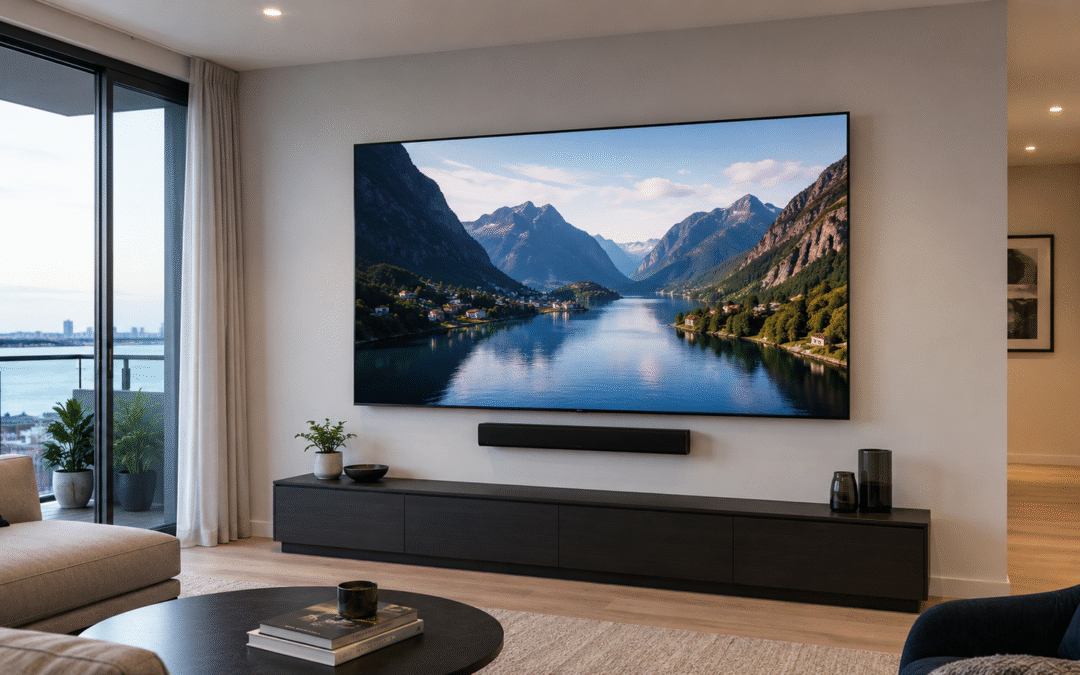
Large TV wall mounting Sydney jobs have become much more common as 75-inch, 85-inch and even 98-inch TVs have become much cheaper to buy. A few years ago, many customers treated a 65-inch TV as the large option. Now, people often walk into a retailer expecting one size and leave with a much bigger screen because the price difference is smaller than they expected.
That can be good value, but it also creates installation issues. An 85-inch or 98-inch TV is not just a normal TV scaled up. The wall type, bracket choice, room size, viewing height, cable location and handling all matter more once the screen becomes larger and heavier. Before mounting a large TV, it is worth checking whether the room, wall and installation plan actually suit the size of the screen.
Why 85-inch and 98-inch TVs are becoming more common
Large TVs are no longer only for luxury home theatres. Retail pricing, sales promotions and wider model availability mean many customers now consider screen sizes that would have seemed out of reach only a few years ago.
This often happens at the point of purchase. A customer may walk into a store expecting to replace an older TV with another 65-inch model, then find that a much larger 75-inch, 82-inch or 85-inch TV is within budget. In that moment, the larger screen can feel like better value.
The problem is that the buying decision is usually made in a large retail showroom, not in the customer’s actual living room. A screen that looks reasonable on a showroom wall can feel much larger once it is mounted in an apartment, bedroom, townhouse or smaller lounge room.
This is why large TV installation should be planned before drilling into the wall. Bigger screens can look excellent when they suit the room, but they need the right wall position, viewing distance and support.
Bigger is not always better for every room
A larger TV can improve the viewing experience, especially for movies, sport, gaming and home theatre setups. But the screen still needs to match the space.
The first issue is wall size. An 85-inch or 98-inch TV needs enough clear wall width around it so the installation does not look cramped. It also needs to sit at a comfortable height, not simply as high as the available wall space allows.
The second issue is seating distance. If the couch is too close, a very large screen can feel uncomfortable, especially in smaller rooms. The viewer may need to move their head or eyes more than expected, and normal TV watching can feel less relaxed.
The third issue is room layout. Windows, glare, walkways, fireplaces, soundbars, cabinets and power points can all affect where the TV should go. Sometimes the best installation position is not the exact centre of the wall, but the position that gives the safest fixing, cleanest cable route and most comfortable viewing angle.
This is why it is worth checking the room before committing to a large TV. The right size is not just the biggest screen that fits on the wall. It is the screen that works with the room, seating position and installation conditions.
Wall type matters more with large TVs
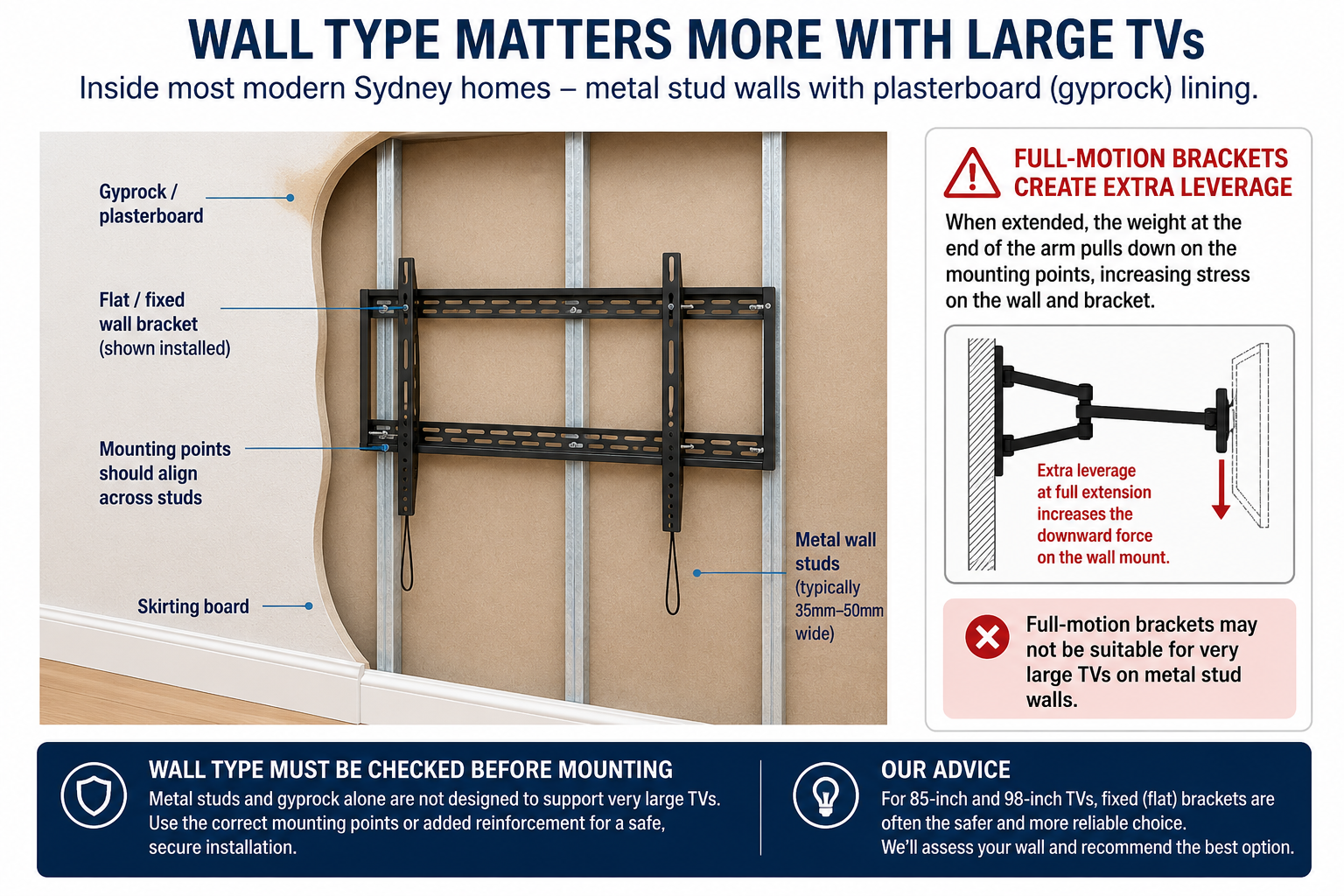
The larger the TV, the more important the wall becomes. A small or medium TV may be easier to position, but an 85-inch or 98-inch TV needs stronger support and more careful fixing.
Brick and concrete walls are usually more straightforward when the correct anchors and installation method are used. Timber-framed walls can also work well when the bracket is fixed into suitable studs. The more difficult cases are often plasterboard walls, metal studs, apartment walls, or walls where the structure behind the surface is unclear.
This is common in Sydney apartments and newer builds. Some walls may have metal framing, limited cavity depth, services inside the wall, or restrictions because the wall is shared with another unit. In these situations, the installer needs to assess the wall before deciding where and how the TV should be mounted.
The main issue is not just weight. Large TVs create more leverage across the wall, especially when the bracket is wide, when the screen is handled during installation, or when a tilt or full-motion bracket is used. A fixing method that seems acceptable for a smaller TV may not be suitable for a much larger screen.
For this reason, large TV wall mounting should be based on the wall structure, not just the customer’s preferred centre point.
Bracket choice becomes more important
The bracket matters more as the TV gets larger. With 85-inch and 98-inch TVs, the wrong bracket can make the installation harder, less stable, or visually poor.
A fixed bracket usually gives the cleanest wall-mounted look. It keeps the TV close to the wall and is often the best option when the screen is being installed at a normal viewing height.
A tilt bracket can help when the TV needs to sit slightly higher, such as above a cabinet or fireplace. But with very large TVs, tilt brackets need to be chosen carefully because tilting the screen changes how the load sits on the wall and bracket.
Full-motion brackets are useful in some rooms, but they are not always the best choice, or even possible, for very large TVs. A large TV extended away from the wall creates much more leverage. The wall, bracket and fixings all need to be suitable for that load. In many homes, especially apartments without solid wall structure, a fixed or carefully selected tilt bracket may be the safer and cleaner option.
The best bracket is not always the most adjustable one. It is the bracket that suits the TV size, wall type, viewing position and cable plan.
Cable concealment and power planning
Large TVs can make cable concealment easier in one way because the screen covers more of the wall. With an 85-inch or 98-inch TV, there is usually more hidden space behind the panel, which gives the installer more choice when deciding where the cables should enter the wall.
The part customers often do not expect is cable length. On many large TVs, the HDMI, antenna, optical or power connections are positioned toward the side or lower side of the panel. Because the TV is wider, the cable may need to travel further across the back of the screen before it even reaches the wall entry point. A cable that worked comfortably on a 55-inch or 65-inch TV may suddenly be too short on an 85-inch model.
This matters most when the customer already has short HDMI leads, a soundbar cable, an antenna lead, a gaming console connection or an AV receiver setup in place. Even if the wall entry point is hidden behind the TV, the cable still needs enough length to reach the TV inputs without pulling tightly, bending sharply or sitting under strain.
The cable plan should be checked before the bracket is installed. This includes power, HDMI cables, antenna, Foxtel or streaming devices, gaming consoles, soundbars and AV receivers. If the TV is part of a home theatre setup, the cable route may need to connect with speakers, a receiver, a soundbar or a cabinet below the screen.
For large TV installations, the cleanest result usually comes from planning three things together: where the TV will sit, where the cables will enter the wall, and whether the customer has cables long enough for the larger screen. Bigger TVs often hide cables better, but they can also expose poor planning if cable length and input position are not checked first.
When to get advice before buying or mounting a large TV
It is worth getting advice before installation if the TV is 85-inch, 98-inch or larger, especially if it is going into an apartment, bedroom, townhouse or smaller lounge room. The screen may physically fit on the wall, but that does not always mean it will suit the room.
Before mounting, check the wall width, seating distance, viewing height, wall type, bracket type and cable plan. It is also worth checking whether the TV box can physically get into the home through the lift, stairwell, hallway or front door.
Getting the TV position right before drilling is important. Once a large screen is mounted, even a small mistake in height or position can stand out. The TV may look too high, too low, too close to one side, or poorly aligned with the cabinet and soundbar.
Large TV wall mounting across Sydney
Easy TV provides large TV wall mounting across Sydney for homes, apartments, townhouses, offices and commercial spaces. We install 75-inch, 85-inch, 98-inch and other large-screen TVs, with advice on wall type, bracket choice, viewing height, cable concealment and safe installation.
If you are planning to buy or mount a large TV, it is better to check the wall and room before installation rather than after the TV arrives. A short planning step can help avoid poor positioning, weak fixing, visible cables, or a screen that does not suit the space.
For related services, see our TV installation page, TV wall mount gallery, home theatre setup and soundbar wall mounting services.